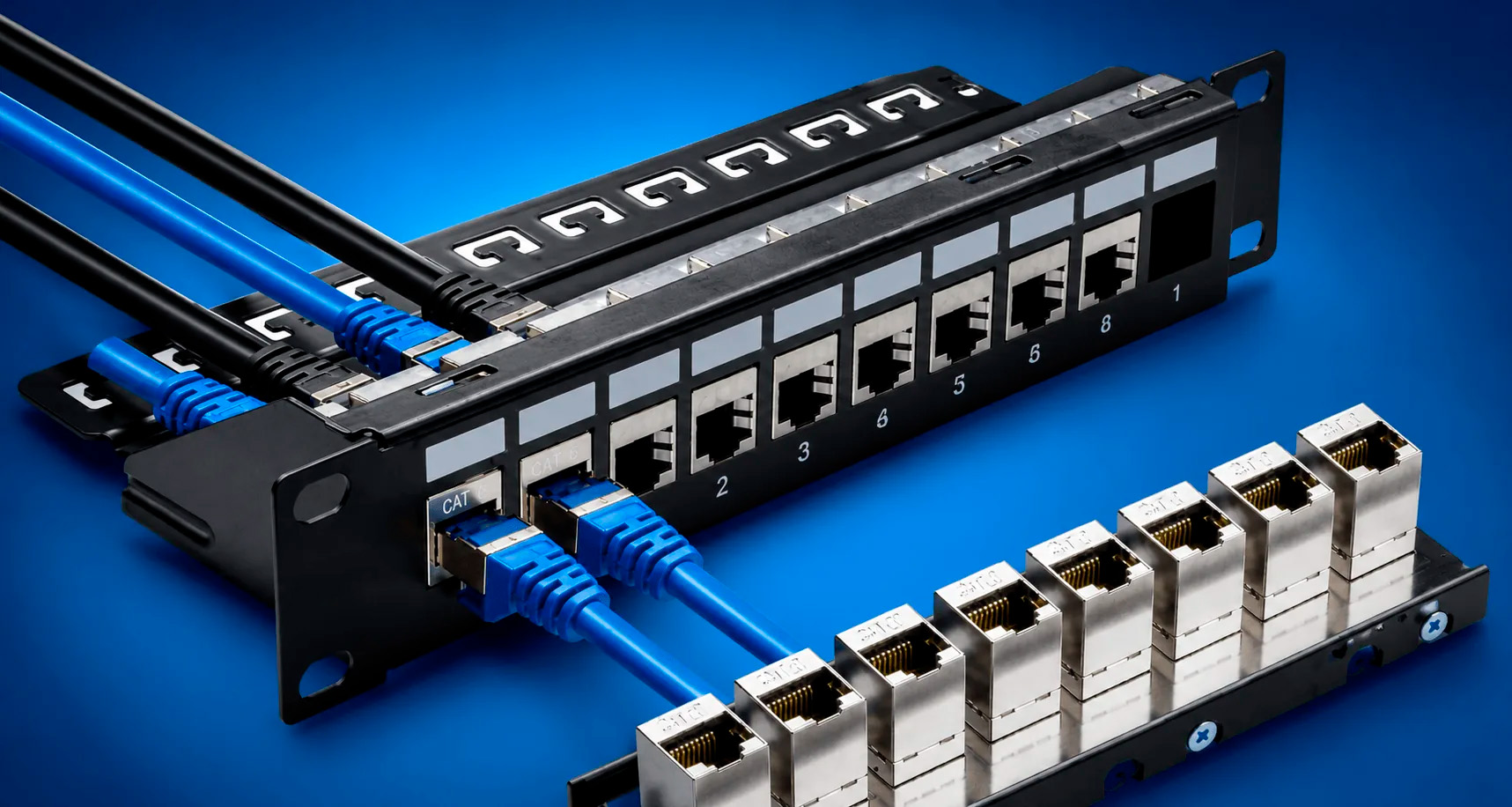
At frequencies above 250 MHz, the signal wavelength becomes short enough that the twisting of UTP (Unshielded Twisted Pair) cable is no longer an effective barrier against external noise. While in lower categories the twist cancels the electromagnetic field through phase difference, in Cat6A (500 MHz) electromagnetic energy tends to “radiate” outside the plastic jacket. By adding a metallic foil, a physical barrier is created that stops radio-frequency waves. This allows the cable to be substantially thinner, improving airflow in racks and allowing a tighter bend radius. The only real “cost” of shielding is that it requires a proper technical grounding infrastructure. If it is not correctly grounded at the patch panels, it can act as an antenna and worsen performance instead of improving it.
One of the main problems is Alien Crosstalk (AXT), the electromagnetic interference produced between adjacent cables within the same raceway. To solve this, shielding acts as a Faraday cage that confines the signal inside the cable and blocks emissions from neighboring cables, allowing shielded solutions to be thinner and easier to handle compared with Category 6A UTP designs.
To transmit data at speeds of 10 Gbps or higher, active equipment (switches) needs a very clean signal.
High-frequency transmissions often coexist with high-power Power over Ethernet (PoE) delivery (up to 90W or 100W).
As we move up the frequency spectrum, the network becomes more sensitive to radio signals and other high-frequency sources.
Technical Factor | UTP Solution (Unshielded) | Shielded Solution (STP/FTP) |
Typical Frequency | Up to 250 MHz (Cat6) | 500 MHz to 2000 MHz (6A, 7, 8) |
EMI Resistance | Moderate | Excellent (Full protection) |
Alien Crosstalk | Managed by physical design | Eliminated by metallic barrier |
Cable Diameter | Thicker in higher categories | More compact and efficient |
Installation Complexity | Low | Medium (Requires grounding) |
For a shielded solution to be effective, the grounding system must be flawless. A shield that is not properly grounded can act as an antenna, making the problem worse instead of solving it.
Do you have a specific environment in mind for this implementation, such as a high-density office or an industrial plant?