The Strategic Value of Certified Structured Cabling

Hiring certified network infrastructure companies is a decisive factor in ensuring the stability and performance of any organization.

By entrusting these projects to specialists, you ensure an implementation based on technical rigor rather than improvisation, allowing connectivity to support today’s data transfer demands. This professionalism translates into a robust network that minimizes communication errors and maximizes the service life of installed components. Beyond the physical installation, the value of a certified company lies in its ability to validate and document infrastructure quality through standardized processes.

This approach ensures the technology investment is protected by objective performance testing, so the speed and efficiency promised by cabling manufacturers are delivered in daily practice. Certified companies operate under strict global standards (such as TIA/EIA-568, ISO/IEC 11801 and ANSI) that eliminate unregulated “own criteria”. Their importance lies in:

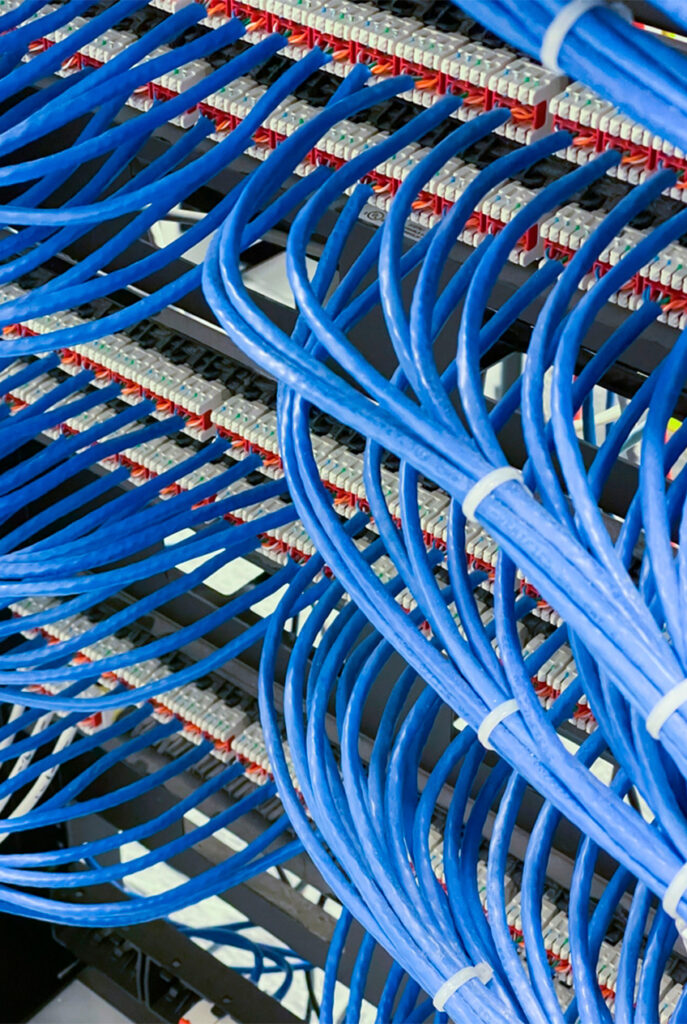
  • Technical precision: Rigorous control of cable bend radius and cable organization.

  • Interference mitigation: Compliance with separation distances from power cables to avoid electromagnetic interference (EMI).

  • Performance optimization: Eliminating the “noise” and packet loss that usually degrade network speed.

Link Certification and Results Delivery

Unlike self-taught technicians, certified specialists deliver formal reports for every installed network point, guaranteeing quality through:

  • Professional Testers: Use of high-end equipment (such as Fluke Networks) to measure critical parameters like attenuation, NEXT (crosstalk) and return loss.

  • Investment Security: A technical obligation to correct any node that fails certification testing.

  • Real Performance: Assurance that a Category 6A network actually reaches 10 Gbps, avoiding limitations caused by poor terminations.


Manufacturer Backing and Warranty

This is perhaps the most important point financially and legally. Major manufacturers only grant extended warranties (15 to 25 years) if the project was carried out by a certified channel.

  • Application Warranty: If in 10 years the cable fails due to material degradation, the manufacturer covers the replacement, but only if the installation was validated by an authorized integrator. A non-certified company will only give you the minimum legal warranty (usually one year).
Risk Mitigation and Human Safety

Professional structured cabling also complies with fire safety standards.

  • Proper Materials: Certified companies use cables with LSZH (Low Smoke Zero Halogen) or Plenum jackets, which do not spread flames or release toxic gases in a fire.
  • Data Center Order: Professional cable dressing in racks prevents switches and servers from overheating.
Scalability and
"As-Built" Documentation

A professional project includes delivery of As-Built drawings and labeling according to the TIA/EIA-606 standard.

  • Simplified Maintenance: When every cable is labeled at both ends and documented on a drawing, troubleshooting takes minutes. In an uncertified network (the infamous “bird’s nest”), finding a problem can take hours or days of downtime.

Conclusion

Cabling represents less than 10% of a network’s total cost, yet it is responsible for more than 70% of connectivity problems. Hiring a certified company removes that risk variable from your business equation.

Are you evaluating a specific cabling category (Cat6, 6A) or fiber optics for a current project?